VibeCheck
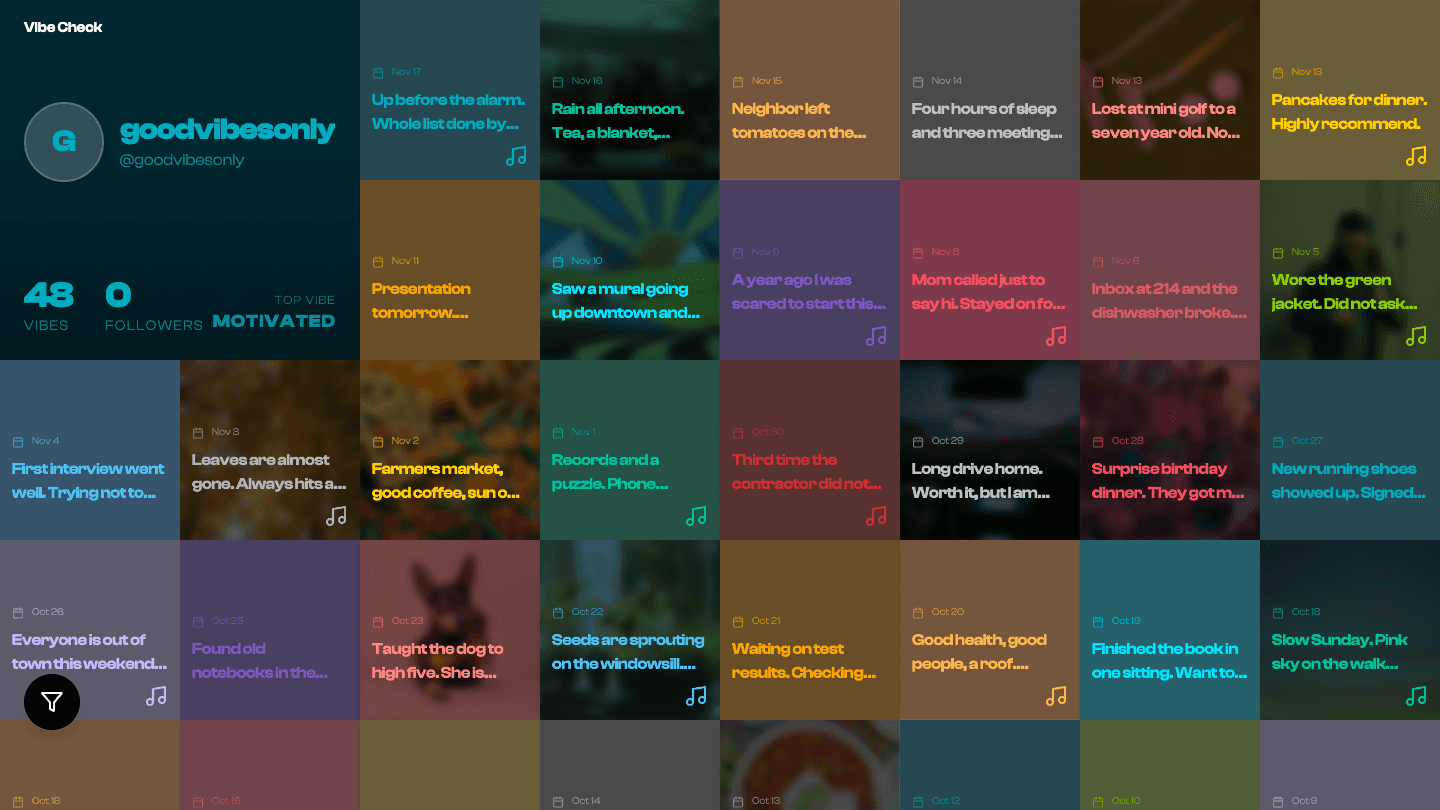
A mood journal prototype. Each day you pick a feeling and add a note, photo, or song, and the days build into a colored quilt of how your year felt.
- role
- Concept, design, and development · working prototype
- status
- prototype
- stack
- Next.js · React · TypeScript · Supabase · Tailwind · Framer Motion · HuggingFace API · Vercel
- Moods
- 16
- Colors
- 176
- Input modes
- 4
The idea
Social feeds reward highlights. I wanted a place to log how a day actually felt, good or bad, and see the pattern over months.
The idea comes from temperature quilts, where knitters add one row a day in a color for that day's weather. In Vibe Check, each day is a square colored by its mood, and a year of entries becomes a quilt.
Where it stands
It is a working prototype, not a launched product. You can sign up, log one vibe a day with a note, a photo, or a Spotify song, edit it later, follow other people, and share a public profile. I built the first version in spring 2025 and picked it back up in December 2025. So far I am the only person who has used it, and it is on hold while I focus on other projects.
My role
Solo project. I came up with the concept and did the product design, visual design, and development.
Product and design decisions
Feelings in the words people use
The app has 16 moods, named the way people talk: happy, chill, motivated, playful, loved, lonely, overwhelmed, tired, and so on. Clinical emotion labels felt like a form at the doctor's office. Everyday words made logging feel like a quick check-in.
One picker that works on any device
Choosing a mood has to take a second, or people stop doing it. I built a single picker that responds to a scroll wheel on desktop, a swipe on phones (tuned separately for each kind of device), arrow keys, and plain buttons.
Color carries the meaning
Every mood has its own palette of 11 shades, 176 colors in all, tuned for light and dark themes. The quilt only works if you can read it at a glance, so color does the work that labels would otherwise have to do.
AI suggests, you decide
When you write a note, a language model reads it and suggests a mood, mapping the 28 emotions it detects to the app's 16. The suggestion appears with its confidence, and you accept it or dismiss it. Getting that balance right, helpful without overriding what you meant, was the hardest product question in the app.
It should feel instant
New entries appear immediately and quietly roll back if the save fails. Photos are compressed in the browser to under 1MB before they upload, so posting from a phone stays quick.
What I learned
- Everyday words for emotions get used. Precise ones do not.
- An AI feature in a personal product should offer, not decide. People need to recognize the result as theirs.
- Supporting several input methods is mostly tuning: what feels right on a trackpad is too sensitive on a phone.